
Residential Condominiums
Individual units in urban condominium towers, typically leased to residents. A common entry point that pairs rental income with long-term value in growing city centres.

An educational, data-driven guide to private real estate investing in Canada — exploring residential and commercial property as an alternative asset class beyond traditional stocks and bonds.
All investments carry risk, including the potential loss of principal. Outcomes are not guaranteed and the content on this page is for informational purposes only, not financial advice.
Private real estate investing pools capital from many investors into a vehicle that acquires and manages physical property — residential, multi-residential, commercial and industrial — that individuals would rarely access on their own. Unlike publicly traded stocks and bonds, these assets are not bought and sold on a daily exchange, which shapes both their potential and their risks.
EquityHub CA exists to explain this asset class clearly and neutrally. We publish independent, data-driven guides for Canadian investors who already hold public-market portfolios and want to research diversification before consulting a licensed advisor.

From pooled capital to a return of principal, private real estate follows a defined lifecycle. Here is the path in four plain-language steps.
Many investors contribute capital to a private real estate vehicle, together reaching the scale needed to acquire properties beyond the reach of most individuals.
Professional managers acquire and operate residential, multi-residential, commercial or industrial assets across markets such as Toronto, Vancouver and Calgary.
Over a defined holding period, rental income and any appreciation accrue within the fund. Returns vary with the market and are never guaranteed.
Investors may receive periodic distributions and, at maturity, the property is sold or refinanced and capital is returned, subject to market conditions.
A few reference points that help frame how private real estate is often discussed. These numbers are illustrative only.
Figures are illustrative for educational purposes only and are not a forecast or a guarantee of any outcome. Always consult a licensed financial advisor before investing.
Private real estate spans several distinct property categories, each with its own income profile and risk considerations.
Individual units in urban condominium towers, typically leased to residents. A common entry point that pairs rental income with long-term value in growing city centres.

Office buildings leased to businesses on longer commercial terms. Income can be steadier, though demand shifts with local economic and workplace trends.
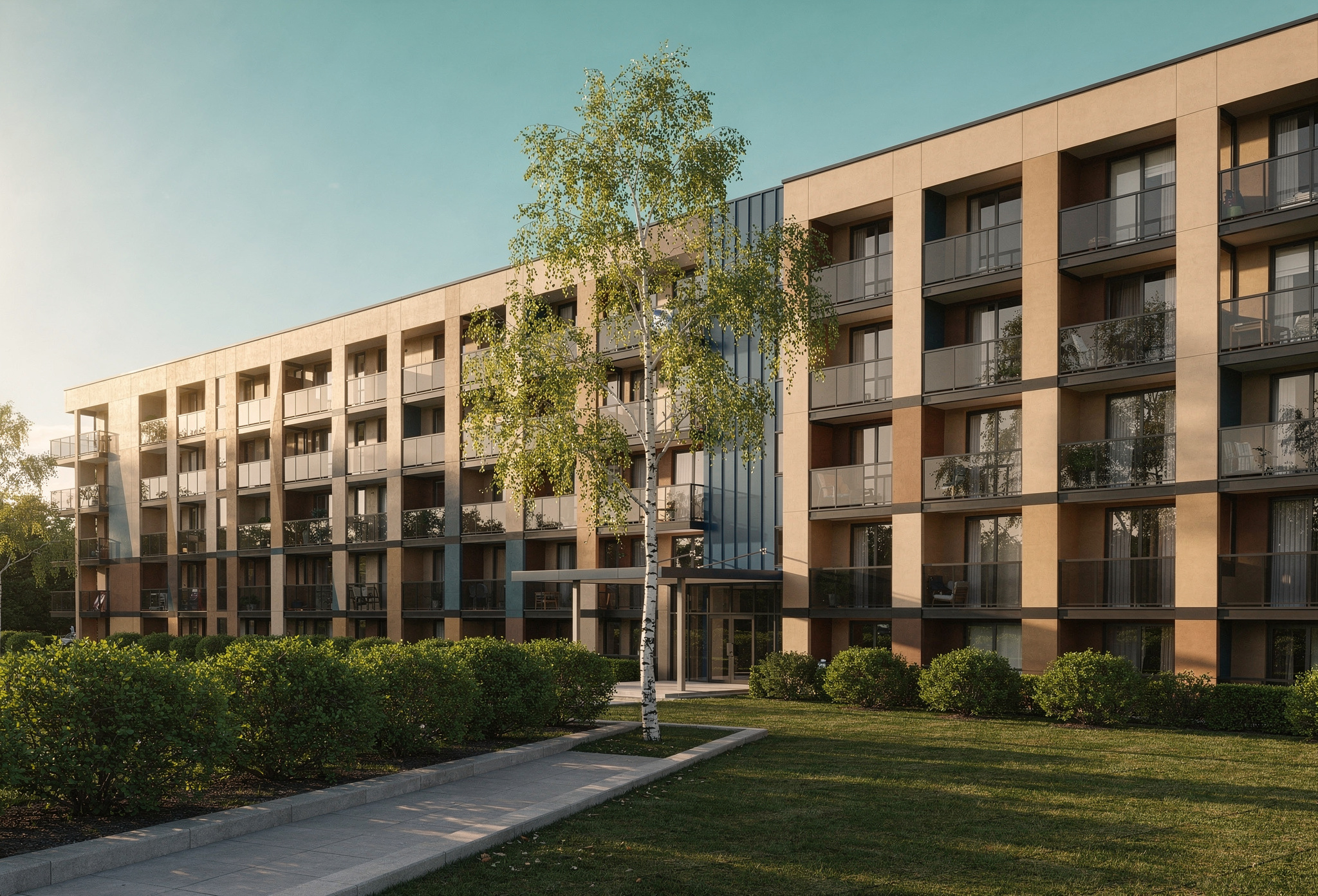
Low-rise apartment complexes with many rental units under one roof. Diversified tenancy can help spread occupancy risk across a single asset.

Warehouses and distribution facilities supporting e-commerce and supply chains. A property class that has drawn growing institutional attention in recent years.
These are balanced reasons investors study the asset class — not promises of returns. Every one carries trade-offs you should weigh against your own goals and risk tolerance.
Exposure to an asset class that does not always move in step with public stocks and bonds, which some investors use to spread risk.
A claim on tangible buildings and land, rather than only paper securities, which appeals to investors who value real, physical collateral.
Tenanted property can generate ongoing rental income during the holding period, though occupancy and rents are never guaranteed.
Multi-year holding periods can suit investors with patient capital who are comfortable trading day-to-day liquidity for a longer view.
Acquisition, leasing and maintenance are handled by experienced managers, removing the hands-on work of owning property directly.
Pooled vehicles can open the door to larger deals once reserved for institutions, though access still carries the same underlying risks.
An illustrative look at how price and rent levels are often compared across Toronto, Vancouver and Calgary. Switch the view to see each measure on a simple relative index.
Values are an illustrative relative index (Toronto price = 100) for education only. They are not real listings, appraisals or a forecast of future prices or rents.
Major metros compared: Toronto, Vancouver and Calgary.
Illustrative price-index spread across the three markets.
Views available — toggle between price and rent on the chart.
A neutral comparison of how the two approaches typically differ. Neither is better in the abstract — each suits different goals, time horizons and tolerance for risk.
The profiles below are hypothetical illustrations created for education. They are not real offers, recommendations or available investments.
 Multi-Residential
A hypothetical pooled investment in waterfront condominium towers with podium townhomes, illustrating how a longer-hold residential asset in a major metro might be framed for educational discussion.
 Residential
A hypothetical development of attached suburban townhomes, used to illustrate how a shorter-horizon build-and-sell residential project might be described and the figures an investor would review.
A short, illustrative history of how access to private real estate in Canada has broadened over time.
Private real estate was largely the domain of pension funds and large institutions, with little practical access for individual investors.
Pooled structures grew in popularity, letting many investors combine capital and gain shared exposure to larger property portfolios.
Evolving regulation gradually opened more pathways for retail investors to participate, alongside clearer disclosure expectations.
Rapid residential and commercial development across major metros such as Toronto, Vancouver and Calgary drew fresh attention to the asset class.
More retail investors now research private real estate as a way to diversify beyond stocks and bonds — which is exactly why neutral education matters.
Enter an amount, a holding period and an estimated annual rate to see a simple compounded projection. This is a teaching tool only — it is not a forecast, a promise of returns or financial advice.
$37,590
A one-time $25,000 contribution compounding at 6% for 7 years.
Results are hypothetical and assume a constant annual rate with no fees, taxes or withdrawals. Actual outcomes vary and are not guaranteed. This is not financial advice.
Two short, plain-language guides — read them in full right here.

Private real estate does not behave the same way in every city. Toronto, Vancouver and Calgary each have their own mix of supply, demand, employment and development activity, and those differences shape both potential income and risk. Reading regional trends means looking past a single headline number and asking what is actually driving prices and rents in a given market.
Supply is often the clearest signal. Where new construction is concentrated, additional units can moderate rent growth even as a city expands; where development is constrained, existing properties may see steadier demand. Employment and migration matter too: metros that attract new residents and stable jobs tend to support occupancy, while markets dependent on a single industry can be more cyclical.
None of this predicts the future. Trends describe what has happened and provide context, not certainty. The goal of reading market data is to understand the questions worth asking — about supply, demand and concentration — before forming any view, and certainly before speaking with a licensed advisor about your own situation.

Liquidity describes how quickly an investment can be turned back into cash without a steep discount. Public stocks are highly liquid: they can usually be sold on any trading day. Private real estate sits at the other end of the spectrum, because property takes time to sell and pooled vehicles often lock capital for a defined term.
This is why holding periods matter so much. A private real estate investment is frequently structured around a multi-year horizon — often five years or more — during which capital is expected to stay invested while the property is managed, income accrues and value is, ideally, built. Exiting early may be difficult or simply not possible under the terms of the vehicle.
For some investors, trading day-to-day liquidity for a longer horizon is an acceptable trade-off; for others it is not. The key is to be honest with yourself about when you might need the money back. Illiquidity is not inherently good or bad — it is a feature to plan around, and a central topic to raise with a licensed financial advisor before committing.
Perspectives on the learning experience. These describe the education, not investment results — no outcomes are implied or guaranteed.
“I finally understand the difference between liquid and illiquid investments. The guides explained holding periods without any sales pitch, which is exactly what I needed before talking to an advisor.”
“As a small-business owner I appreciated how neutral the content is. It lays out the risks as clearly as the opportunities, so I felt informed rather than sold to.”
“The regional market breakdowns helped me ask better questions. I came in curious about diversification and left with a much clearer sense of what to research next.”
Please read these points carefully. They are central to understanding everything else on this page.
All investments carry risk, including the loss of principal. You may receive back less than you invested, and there is no guarantee of any return.
Private real estate is illiquid. Capital is typically locked for a multi-year holding period and may not be accessible when you want it.
Past performance does not predict future results. Historical trends and market data describe the past and offer no assurance about the future.
All figures on this page are illustrative. Numbers, charts and example profiles are for education only and are not offers, appraisals or forecasts.
Consult a licensed financial advisor. EquityHub CA provides education only and does not give individualised financial, tax or legal advice. Seek professional guidance before investing.
Plain-language answers to the questions readers ask most about private real estate investing.
Six factors worth weighing carefully before committing to any private real estate investment. Each is a question to research, not a box to tick.
Understand how long your capital is expected to stay invested and whether that horizon fits your own plans for the money.
Know how difficult it may be to exit early, and never invest money you expect to need on short notice.
Read how the vehicle is structured and what fees apply, since costs and terms can meaningfully affect net outcomes.
Consider how exposed an investment is to a single city or property type, and what that concentration means for risk.
Be honest about how much volatility and potential loss you can accept, both financially and emotionally.
Plan to discuss any investment with a licensed financial advisor who can weigh it against your full financial picture.
Have a question about private real estate education? Send us a note and a member of our editorial team will reply by email. We provide information only — no sales calls, no commissions and no individualised financial advice.
Email and the form are the only ways to reach us. We aim to respond within a few business days.